"On Second Thought - The Real Vampires" Interview w/John Edgar Browning & Merticus Georgia Public Broadcasting (GPB) Public Radio - August 5, 2015 http://www.gpb.org/on-second-thought/episodes/307
"Prava istina o nama (The Truth About Us)" (Merticus & Maloryn) "Dracula Is Only A Fiction, It Is Time To Meet Us" [Cover] By Aleksandra Vizin of Urban Magazine (Bosnia-Herzegovina) - Pages 108-112 - May 2011 http://www.atlantavampirealliance.com/forum/index.php?topic=2425.0
"¿Querés Ser Un Vampiro Real?" / Want To Be A Real Vampire? "El Escritor Freak D.J. Williams Investigó Sobre Comunidades Que Intercambian Sangre Como Alimento. ¡Crepúsculo Y Más Allá!" By Silvina Marino of Si Clarin - March 17, 2011 http://www.si.clarin.com/Queres-vampiro-real_0_446355372.html
"The Bachelor Vampire Madison Garton Is Acress Madison McKinley" (NYC Vampire Subculture) By Asa Hawks for Starcasm.net - January 3, 2011 http://starcasm.net/archives/79547
Vampire Community Research | Media | History Archive The World's Largest & Most Comprehensive Repository Of Information Concerning The Real Vampire Community - January 1, 2011 http://www.suscitatio.com/forum
"Interviews With The Vampires: The Real Story Behind New Orleans’ Vampire Subculture" By John Edgar Browning for Deep South Magazine - February 3, 2010 http://www.deepsouthmag.com/?page_id=82
"Real Vampires & The Vampire Subculture" Special Report by Suzanne Stratford of FOX 8 News (Cleveland, OH) - November 6, 2009 http://www.youtube.com/watch?v=knKCKvJ-icE
"Night Neighbors" - FOX News Channel Hannity's America w/Michelle Belanger & Anshar Seraphim- December 7, 2008 Members Of America's Vampire Subculture Could Be Living Right Under Your Nose http://www.foxnews.com/hannitysamerica
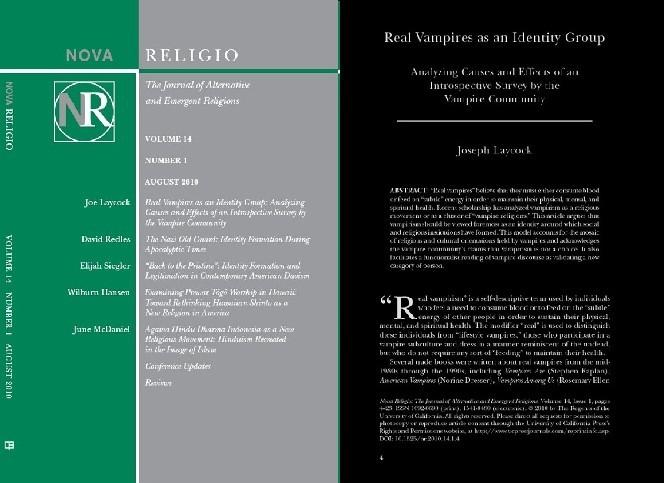
Real Vampires as an Identity Group: Analyzing Causes and Effects of an Introspective Survey by the Vampire Community By Joseph Laycock, PhD Nova Religio - The Journal of Alternative and Emergent Religions August 2010, Vol. 14, No. 1, Pages 4-23
"Real vampires" believe that they must either consume blood or feed on "subtle" energy in order to maintain their physical, mental, and spiritual health. Recent scholarship has analyzed vampirism as a religious movement or as a cluster of "vampire religions." This article argues that vampirism should be viewed foremost as an identity around which social and religious institutions have formed. This model accounts for the mosaic of religious and cultural orientations held by vampires and acknowledges the vampire community's claims that vampirism is not a choice. It also facilitates a functionalist reading of vampire discourse as validating a new category of person.
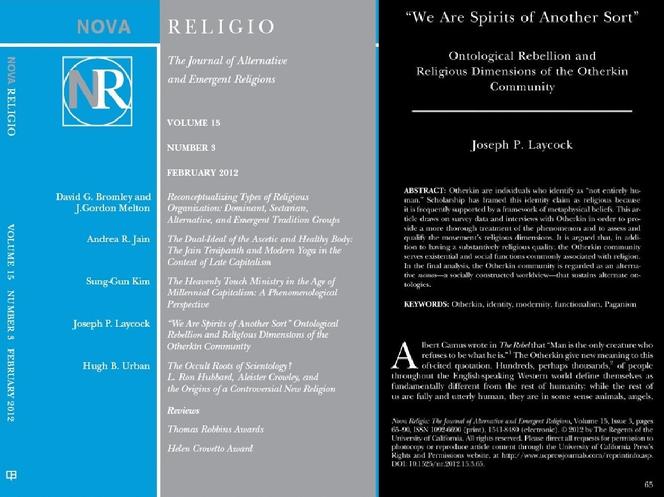
We Are Spirits of Another Sort: Ontological Rebellion and Religious Dimensions of the Otherkin Community By Joseph P. Laycock, PhD Nova Religio - The Journal of Alternative and Emergent Religions February 2012, Vol. 15, No. 3, Pages 65-90
Otherkin are individuals who identify as "not entirely human." Scholarship has framed this identity claim as religious because it is frequently supported by a framework of metaphysical beliefs. This article draws on survey data and interviews with Otherkin in order to provide a more thorough treatment of the phenomenon and to assess and qualify the movement's religious dimensions. It is argued that, in addition to having a substantively religious quality, the Otherkin community serves existential and social functions commonly associated with religion. In the final analysis, the Otherkin community is regarded as an alternative nomos--a socially constructed worldview--that sustains alternate ontologies.
FOX 8 News - "Real Vampires & The Vampire Subculture" Friday, November 6, 2009
Special report by Suzanne Stratford with interviews from Michelle Belanger and the Atlanta Vampire Alliance [AVA].
True Voodoo Produced By: Edward Paige & Liane Su (2010)
True Voodoo Vampire Ball
The Vampire community is celebrating "Endless Nights" in New Orleans. But The Vampire Zaar (Belfazaar) is suffering from a broken fang and before he can go to the ball, he must seek out the elusive Fang Smith, The Maven.
ABC 20/20 - "Inside The World Of Real Life Vampires" Friday, November 27, 2009
Geraldo At Large (FOX News Channel) - "Real-Life Vampires" Sunday, November 22, 2009
What is the fascination with vampires?
Interviews with Joseph Laycock; author of "Vampires Today: The Truth
About Modern Vampirism" and Sky & Vlad; vampires and fire
performance artists.
A while
back, I was talking about the Global Vampire Community Discussion, and
how important it is for members of the vampire subculture to get
together, discuss real issues, and maybe promote more progress, with
other members who might be a little behind on the times. It’s easy for
a subculture to branch off and become too like an exclusive clique, not
allowing some to join, or even answering questions of more curious
individuals. The GVCD, for short, brings a lot of important issues to
light, and for the purpose of furthering some of that educational
spirit, I’ve asked a few of the meeting’s members, such as Zola
Zimmerchild, and Isealdor from Vampires.nu (http://www.vampires.nu), as well as one of the founding member’s of the AVA, Atlanta Vampire Alliance (http://www.atlantavampirealliance.com),
Merticus, to grace us with a short interview. You can get in touch with
any of these people by reading the transcript of the GVCD that is
included in the original Global Vampire Community Discussion. So
without further ado, we hope that we’ve shed some light on your
fascination with real vampires.
Q: What do you think is the largest major concern facing the modern vampire subculture?
Isealdor:
I would say that currently, the largest concern and struggle for the
modern vampire subculture is trying to solidify identity and structure
for the various facets in the subculture. There are so many groups and
communities within the subculture and so much crossover between them
that it’s difficult for a lot of the groups and people to really settle
on a set identity as a group and agree on it, especially without
excluding those who do cross over from one aspect of the subculture to
another. For example, there are those who are part of the subculture by
subscribing to the vampire lifestyle or role-play aspects, those who
identify as real vampires, or those who consider themselves vampiric or
use vampiric practices in conjunction with things like ritual
magick…however, there are a good many who identify as real vampires who
also enjoy following a vampire lifestyle, so the lines between and
sense of identity of each of the facets tends to blur, while the
subculture at large is striving to define them more clearly. This
struggle tends to manifest itself in arguments about definitions and a
high prevalence of “us vs. them” mentalities and speaks of an overall
unwillingness for people to simply agree to disagree.
Merticus:
By my own estimation, the vampire community or subculture risks
significant contraction due in large part from the lack of those
willing to invest the time and energy in mentoring and assisting others
who’re awakening or trying to comprehend their own personal vampirism.
The flood of media and pop-cultural interest in the vampire archetype
along with those who identify with modern or real vampirism has led
many in the community to step back from active roles, retreating to
their own established private groups or comfort zones away from the
limelight. While I sympathize with this reaction, I also see a void
being formed as new seekers and awakening vampires are left in many
cases to read articles from individuals who’ve long since vanished from
the community, browse an ever-shrinking number of vampire-related
forums, and search for information amidst a plethora of web sites which
sometimes may provide poor information or a blending of fiction and
reality.
This concern can most adequately be addressed by steps
some in the community are taking now towards the streamlined
organization of information and by the networking of various online and
offline groups. Everyday life obligations have taken precedence and in
some cases the patience has waned with some leaders in the community
who once were available and eager to take the time to be available to
the curious. Making sure that detailed information is readily available
and searchable on the internet or in published books is very
important. This is one of the reasons the Voices of the Vampire
Community (VVC) (http://www.veritasvosliberabit.com/vvc.html)
has consistently posted transcripts of our public meetings and global
community discussions. Our hope is that the vampire community will
begin to solidify a more defined set of goals and direction moving into
the future.
Zola Zimmerchild: Being taken seriously. So
many times I’ve run into, “you can’t be serious,” or something along
those lines. People don’t want to realize that our condition is real.
Q:
What would you say is holding modern vampires back, as a group, from
social integration? Is the blame interior, exterior, or shared?
Isealdor:
I would very much say the lack of total social integration is from a
mixture of reasons from both within and outside of the subculture.
First and foremost that I often see is the lack of desire for social
integration from within the community. By and large, the subculture is
one that is defined by how we are different than those outside of the
subculture, and, perhaps unfortunately, that’s often one of the major
drawing points for many coming into the community; we set ourselves
apart as being somewhat different, even define ourselves by a
difference between us and the rest of society, so many who come into
the community feel that they are different in some way or another, find
a place in the subculture, and feel validated in that feeling of being
different, and even are often subtly encouraged to maintain that. That,
in turn, directly effects how modern vampires are perceived by those
outside of the group, because the group will intentionally do things to
set themselves apart, leading to some of the exterior reasons for a
lack of social integration. Those on the outside are likely to simply
look at those involved in the vampire subculture and simply view us as
being different, and treat us accordingly, increasing some of that
distance. However, I think the primary influencing factors from those
outside of the subculture preventing social integration are general
ignorance and apathy; people, by and large, do not know much about the
subculture unless they are involved with it in some way or another, nor
do they have any desire to learn, which is understandable, given it
doesn’t affect them.
Merticus: There’s a myriad of forces
exerting negative pressures on the vampire community from all sides.
This phenomenon is not new nor should any of us expect it to ever
completely disappear. For one, the books, films, and artistic
depictions of the vampires lead to increased attention and
intra-community groveling about having to answer inane questions from
teenagers wanting to learn how they can be transformed into vampires.
Along with the occasional deviant labels cast onto vampires by the
media and satanic panic charlatans who seek to prey on the fears of the
public, there are also individuals within the community who thrive on
chaos, misdirection, and ego trips akin to extreme narcissism.
While
many of us strive to educate those outside of community that we harbor
many of the same concerns, emotions, and feelings as anyone else
without infringing on the rights of others, there are those who
interpret this outreach as counterintuitive to the fundamental spirit
or concept of the vampire. They argue that the actions and beliefs of
sanguinarian, psychic, and other vampiric identities are a private
matter warranting no need for explanation to those on the outside. I
believe there is a delicate balance which must be maintained between
the desire for privacy and anonymity with the transparency of certain
aspects of vampirism if we wish to be recognized as a legitimate
identity group. Social integration is not the consummate goal of most
vampires so much as having the respect of others to allow us the right
to coexist without prejudice or retaliation against our practices,
beliefs, or state of our existence.
Zola Zimmerchild:
I’ve run across several people who don’t want to integrate, they would
rather stay separate, and for the most part, secret. Mostly because of
how we’ve been received so far. So, I believe, that the blame is
defiantly [sic] shared.
Q: We get many inquiries from people interested in “becoming” vampires, what advice can you give for those interested?
Isealdor:
Whenever I get questions from those seeking to become a vampire, what I
find most often is they aren’t really aware of what vampirism is or
what they are wanting, or why. My best advice to them would be to learn
everything they can about vampirism and vampires and what it means for
someone to be a vampire, and for them to stop and consider why they
wish to be a vampire and what they believe would actually change or be
different if they were. More often than not, the majority of those
seeking to “become vampires” are dissatisfied with their lives and
think vampirism may somehow change their current situation, are caught
up with the romanticized appeal of the vampire archetype, and are
interested in the vampire lifestyle and role-play aspects. Through
education, they’re likely to discover they really don’t want to be a
vampire—they want to either be part of the vampire lifestyle scene or
want to learn things like energy working.
Merticus: The
prevailing view of most vampires is that we are born as such or possess
a latent predisposition to awaken to what we metaphorically refer to as
“vampirism”. Vampires are not turned, made, or otherwise created by a
series of steps, adherence to any particular doctrine, magickal
invocation, or the adornment of fangs and other fanciful vestments.
While some may argue vampirism is glamorous or that it affords someone
an increased proficiency in one attribute or another, many would be
quick to point out negative physical, psychological, and other
impediments towards living a healthy and balanced life. Only you can
determine for yourself if you are vampiric and then only by serious
introspection, healthy skepticism, and the ruling out of other factors
such as medical conditions or a passing fascination with vampires.
Nothing about vampirism is transitory nor should it be sought after as
if it were some coveted blessing.
Zola Zimmerchild: To be
happy with who they are. Being a vampire is no picnic, there are many
of us who would choose not to be this way, if given the option.
Q:
Some feel that the vampire subculture is exclusive, and that there’s a
lot of inner turmoil about what exactly is expected of a modern
vampire. Can you give a firm definition of what a vampire is in your
own opinion or experience?
Isealdor: My definition of
what a vampire is is multifaceted, because I see the many applications
of the label as equally valid, though very distinctly different. As
such, I’d say “vampire” is a seven-letter word that has been assigned
to and associated with so many things and has so many varied
definitions, depending on who you are asking, that I think it now
borders on being utterly meaningless as a description, because there is
no one set definition.
There are first, of course, the vampires
of fiction and folklore, ranging from those like Dracula, truly a
zombie-like undead, to the romantic versions of the word embodied by
the likes of Anne Rice’s Lestat and Louis, to the teenage, sparkly
beings out of the currently popular Twilight series. Or, in a less
dramatic sense, the historical instances of people who were buried
alive, then exhumed only for people to find that they’d clawed at the
insides of their coffins. Then there are also the medical,
pseudomedical, and pseudoscientific types of vampirism, such as the
thoughts populated of porphyria and the V5 virus, and the vampirism of
animals or insects who are termed such only because their diet is
purely of blood. Next, there are those who consider themselves vampires
by their choosing to follow a vampiric lifestyle. This tends to split
into two categories; those who actively drink blood or draw
metaphysical energy from others and, as such, are vampiric, and those
who follow a more neogothic lifestyle, complete with capes, fangs,
sleeping in coffins, and wearing white makeup and entirely black
clothing. To further confuse matters, some of these vampires, often
referred to as lifestylers by themselves and others, may also be
vampires of other definitions of the word and simply also choose to
live a vampiric lifestyle.
Finally, the definition I most
commonly use when talking about vampirism and vampires revolves around
a modernistic metaphysical and need-based description. I personally
would say that a vampire is someone who requires a supplement, gained
either through physical consumption of certain things (such as blood)
or via the direct absorption of metaphysical energy, to be able to
maintain the balance of their system; that such need for
supplementation to their system is long term and constant; and is not
caused by addiction, fetish, temporary injury or illness (physical or
to their energy system), or influence from an outside source.
Merticus:
It’s important to understand that the vampire community (subculture)
and vampirism are two different entities. The politic of the vampire
community or the socialization of vampires with other vampires
sometimes gives way to a perception of exclusivity, hierarchy, or other
trappings. This is largely dependant on who one interacts with or to
what level one is willing to immerse themselves in the culture. There
is no prerequisite for those who are vampires to participate at any
level with the greater community or for vampires to dogmatically follow
any specific protocol. The act or state of vampirism is likewise
interpreted through a variety of different lenses depending on the
group or individual. I broadly define sanguinarian and psychic
vampirism as follows:
A vampire is essentially an energy feeder
or blood drinker that may display various levels of psychic ability.
While the causality, interpretation, and sometimes even the “proper”
spelling of vampirism are debated, vampires are generally individuals
who cannot adequately sustain their own physical, mental, or spiritual
well-being without the taking of blood or vital life force energy from
other sources; often human. Without feeding the vampire will become
lethargic, sickly, depressed, and often go through physical suffering
or discomfort. To a degree, the specifics of vampirism manifest
differently on an individual basis and these nuances sometimes insulate
the confusion in defining the vampiric range of ability and experience.
Zola Zimmerchild: My basic definition of vampire is; a person who needs to consume energy or blood in order to maintain a healthy existence.
Q:
From reading over your group meeting, I noticed that there were a lot
of complaints about vampires that are simply “roleplayers”. How do you
feel about the theory that sometimes, roleplaying actually serves as a
welcoming door to the vampire subculture?
Isealdor: I
would say that the roleplay community is part of the vampire subculture
as a whole, and very often functions as a introduction to the rest of
the subculture for many people. I don’t think, however, that I would
particularly consider it to be a welcoming door, simply because there
is so much stigma in the other parts of the subculture against those
who are part of the more roleplay aspects. A door, certainly, but
perhaps more of a backdoor than an overly welcomed one. However, one
cannot ignore that a large portion of the structure of the subculture
in general was originally taken from the roleplay communities and
adapted to suit the needs and purposes of the communities at large. One
notable example of this would be the prevalence of Houses, Courts, etc.
in the real vampire community. While they are not roleplay oriented
groups and communities, much of the initial terminology and structure
was borrowed from various roleplay games. As such, roleplaying can very
much introduce people to at least some of the structural and cultural
dynamics of the rest of the subculture, if not the nuances of the
terminology that has [sic] been changed and adapted over the years to
suit different purposes.
Merticus: Generally a distinct
line is maintained between vampire roleplayers or dabblers with that of
the actual vampire community or subculture. Those who come into the
community from the aspect of roleplaying games or fantastical ideas of
vampires and frequently interject this in their conversations or posts,
often find themselves shown the door on forums and in groups. However,
this is not to say that many vampires don’t find their way to the
community through the gateways of roleplaying games and even other
overlapping subcultures. Generally those with the presence of mind to
quietly observe and learn all that they can from reading before
choosing to interact are the one’s [sic] that distinguish themselves as
the ideal well-rounded participant; able to discern the difference
between healthy fantasy and reality.
On the other hand, there is
often a blurred line between that of lifestyle vampires and the
vampires who insist upon the need to feed from either blood or
life-energies. Wearing prosthetic fangs, attending Goth clubs, and
possessing a passion for a darker or more esoteric side of life doth
not a vampire make. However, none of these factors exclude one from
being a vampire either. It’s not uncommon to find individuals who
embrace the stereotypical vampire image but privately adhere to the
feeding practices and beliefs held by real vampires. The ability for
other vampires to determine who among the lifestylers are indeed real
vampires, is often a key challenge and area of contention for some in
the community.
Zola Zimmerchild: I am open to all sorts
of avenues to exploring and learning about different culture and
societies. If playing a roleplaying game about vampires leads someone
to learning about the real subculture, and want to participate in it
seriously, that’s great.
Q: There are very few “vampire
crimes”, i.e., crimes involving a vampire perpetrator and a non-vampire
victim, but the vampire assailants of the modern era are infamous, and
quickly become completely blown out of proportion. How does the vampire
community, in your opinion, react to these setbacks?
Isealdor:
By and large, the majority of the community tends to be either
oblivious to the few “vampire crimes” that do come up from time to
time, or simply don’t care and ignore them. Virtually all of the
vampire crimes and criminals come from the very fringes of the
community or, more often, from outside of the community, and so the
impact on the community itself is very small. The only reaction that
typically happens in the community at large has more to do with those
who come into the community, asking if we are like whatever criminal,
or if they were one of us, and so a general response is often given
that the community tends much, much more toward nonviolence and is
comprised of those who are more representative of the norms of society
as far as being typically law-abiding goes.
Merticus:
Real vampires are too often mistakenly thrust into the same category of
ritual animal or human sacrifice, fetishism or classified as some other
form of paraphilia, fanatical religious expression or cults, and
labeled as unstable threats to themselves and others. We are almost
universally not the individuals who commit ritualistic crimes involving
human sacrifice, cannibalism, and murder as sometimes portrayed by the
media. We resent when the actions of mentally disturbed individuals are
lauded as an example of an inextricable link to modern vampirism; some
going further to insinuate that our subculture encourages and condones
such behavior. Those who commit acts of violence or similarly egregious
behavior within the vampire community are almost universally
roleplayers or dabblers who’ve lost touch with reality or long-term
psychologically imbalanced persons who pose a threat to society whether
they label themselves as a “vampire” or not.
As a community,
we’ve weathered most of these recent depictions by being both diligent
to the awareness of instances where such distinctions are made and
quick to respond with letters or counter arguments when appropriate.
Despite individuals such as Don Rimer and Dawn Perlmutter who help
contribute spurious information that leads to further negative
depictions of vampires; I’m trying to remain optimistic that we are
making positive strides towards being better understood by those in law
enforcement and represented more accurately in published media articles.
Zola Zimmerchild:
It’s always upsetting that vampire gets attached to an individual that
commits a crime, of any kind, or that they use being a vampire as part
of the excuse for those crimes. Often when this happens, people will
say that that is the reason why we shouldn’t be public. That we should
continue to be hidden from those that are not a part of our “world.” I
also see outrage and people want to make statements in regards to these
individuals, to show that we do not condone such acts as they have
committed, but no one seems to know where to begin or how exactly to
address these things.
Q: What statements do you have for the “non-believers”, those reading who are particularly cynical of the vampire subculture?
Isealdor:
I wholeheartedly invite those who are nonbelievers or cynical, and
particularly those who are truly skeptical, to learn everything they
can about vampirism and about the vampire community, and challenge them
to make attempts to understand the subculture and its various groups.
If one professes to be a non-believer in something, I think it behooves
them to truly understand what they are not believing in, since there is
a good deal of difference between not having a belief in something and
disbelieving it. On the specific topic and branch of real vampirism and
the real vampire community, I would encourage those who are cynical or
skeptical to view the community as a subculture and identity group, and
consider it from that perspective, rather than trying to force those in
the community into the mold of following a specific belief system. I
believe that helps considerably in trying to understand the beliefs and
views of those in the community, as well as understanding the community
at large, even if one completely disagrees with the beliefs that are
commonly held by those in the community. I also encourage anyone truly
interested to speak with people in the community directly, with an open
mind (though not so open one’s brains fall out), and to truly consider
and weight [sic] everything they are presented with, rather than coming
into the community with the expectation of having people willing and
wanting to “prove them wrong”. Open-minded skepticism and critical
thinking, as well as a liberal application of logic, can go a very long
way when attempting to understand a group dissimilar from one’s self.
Merticus:
There is nothing wrong with true skepticism and this is something that
should also be practiced by those who are part of the vampire community
when questioning the reality of their vampiric experience. I’d advise
anyone who is skeptical or even cynical to study all of the available
information on vampirism written by those in the community as well as
by outside researchers. If you have the opportunity to attend a
gathering with those who identify as vampires take the opportunity and
ask questions of those you meet. It’s easy to dismiss a group of
individuals whose experiences are unlike your own or are outside of
your area of expertise. Many in the vampire community are willing to
engage with skeptics and non-believers alike who are willing to engage
in serious and respectful dialogue. More often than not, people who
think they have nothing in common with someone who identifies as a
vampire are surprised to find themselves engaging with one on an
intellectual level if given the opportunity.
Zola Zimmerchild:
Our condition is real. We do not expect you to just take our word for
it, but we live with it. We do not claim superhuman powers or
abilities. We are not going to burst into flames if we go into the
sunlight, and many of us even enjoy garlic. We are pretty much like
everyone else, except for how we maintain our health.
Q: Many
people believe that modern vampirism is nothing short of a bio-hazard,
because of the blood transfers involved. How do you practice safety,
and what advice can you offer others?
Isealdor:
Safety, in everything from dealing with online predators and standard
online safety, to emotional and relationship risks and safety, to
bio-hazard and medical well-being concerns in relation to bloodletting
practices and the health of all involved is one of the universally
promoted things in the vampire community. I see the main key to safety
being common sense and education. Everyone involved in any sort of
relationship, be it online communications with others to a
donor-vampire relationship involving blood feeding, needs to be fully
educated of the risks and concerns involved with what they’re doing, as
well as be constantly vigilant about their health and safety. One of
the first things I often tell people when they come into the community
complaining of physical symptoms is to see their doctors, to make sure
there are [no] medical conditions they are suffering from. The same
goes for anyone wanting to be involved in bloodletting—proper eduction
of anatomy, the risk factors involved in any sort of bodily fluid
exchanges, and warning signs for dangerous situations are heavily
stressed. One of the most important things I particularly advocate is
discouraging the use of medical paraphernalia such as needles unless
the parties involved have been professionally trained to use them and
know and understand all of the problems that can arise with them. When
it is possible for the individual, which isn’t always the case, I
advocate opting for non-physical methods of feeding. However, likely
due in large part to the vigilance on the part of the community as a
whole about safe practices and the social disapproval and often
ostracization within the subculture toward anyone who doesn’t conform
to safe practices, there doesn’t seem to be a high rate of bio-hazard
related issues within the community. In fact, according to one of the
newest sets of results from the VEWRS survey (http://www.suscitatio.com)
(a survey conducted across the vampire and energy working communities),
the prevalence of HIV/AIDs in respondents is slightly below the
national average, which would likely not be the case if there was less
emphasis on safety.
Merticus: Sanguinarian vampirism is
only one feeding method ascribed to vampirism and therefore when one
refers to modern vampirism it should not be automatically interpreted
as always involving blood. When blood feeding is involved, we go to
great lengths to both educate ourselves and provide for the safety of
all those involved. This education on safe feeding methods, includes
basic anatomy and physiology, first aid, sterilization, disease
prevention, and safer sex practices. In all matters relating to feeding
we exercise judgment with a clear and alert mind, acknowledging the
bond between vampire and donor. Anyone who performs an activity that is
knowingly harmful, negligent, or contrary to the prior expressed
desires of a donor may endure harsh and openly voiced or published
criticism within the vampire community as well as potentially become
subject to involvement from law enforcement.
Anyone who
participates in blood feeding (both vampire and donor) should be
regularly tested for blood borne diseases and provide paperwork of a
clean bill of health as necessary to their donor or partner. I’d
encourage others to read up on documents such as The Donor Bill of
Rights (http://www.sanguinarius.org/articles/dbor.shtml), The Black Veil v2.0 (http://www.sanguinarius.org/articles/black_veil_2.shtml), The Vampiric Ethos (http://www.atlantavampirealliance.com/educational/ethicalguidelines.html),
and other individual group or House ethics and feeding guidelines.
Furthermore, one should supplement their knowledge by independently
researching disease prevention, blood testing, and wound care.
Zola Zimmerchild:
I currently do not have a donor for my blood needs, I use animal blood.
As for advice, I would strongly suggest training in phlebotomy, for
blood retrieval, and to make sure that their donor is free of
communicable diseases. As for other methods of blood retrieval, I
suggest reading up on safe blood letting practices, this should include
using sterilized equipment, and proper wound care. The vampire should
also make sure that they are free of communicable diseases, if they do
not use the cupping method when retrieving the blood.
Q: Do you have any recommended reading for those seriously ready or curious about joining the vampire lifestyle?
Isealdor:
I recommend anyone interested in the vampire subculture and communities
to read most everything they can get their hands on, join at least some
of the discussion forums or elists, and to take part in the online
chats or attend whatever meetup group gatherings that may be local to
them, and talk with those in the community. There is an overwhelming
plethora of information available online, even in several languages,
and given the ease of accessibility of the internet, websites like the
VVC website (http://www.veritasvosliberabit.com/vvc.html), the Vampire Realm of Darkness (http://vampires.nu/), Sanguinarius’s Real Vampire site (http://www.sanguinarius.org/), and the Real Vampires Google search engine (http://tiny.cc/VampireGoogle),
which is a custom search for the major and a number of the smaller real
vampire websites, are all wonderful resources for those interested.
Also, for sources in the printed form, I would very highly recommend
“Vampires Today: The Truth about Modern Vampirism” by Joseph Laycock
and Michelle Belanger’s “The Vampire Codex”.
Merticus:
I’d recommend the following two books that both provide a detailed
overview of vampirism and the vampire community; one from a scholarly
or sociological perspective and one from the experiences of vampires
themselves:
I’d
also encourage anyone who’s interested in exploring both the
sociological and phenomenological aspects of vampirism to examine the
findings of the Vampirism & Energy Work Research Study conducted by
Suscitatio Enterprises, LLC in association with the Atlanta Vampire
Alliance [AVA] (http://www.suscitatio.com/) from 2006 to 2009.
Q:
Do you think popular vampires in fiction, film, and television set you
back in terms of popularizing superstitious beliefs, or ahead, in terms
of curiosity and interest in the lifestyle?
Isealdor:
I would say the current vampire craze has both helped and hindered the
vampire community, having both created new fictional beliefs about
vampires and re-popularized old ones, and having opened up a platform
of interest in the community and subculture in general. The increased
interest and curiosity of the general public can be both a good and a
bad thing. While we are now regularly asked if we sparkle in the
sunlight and the community is growing extremely rapidly, people out of
the community have had the opportunity to express their thoughts and
beliefs about vampirism on major news networks and portions of the
academic world has started to take a more serious interest in the
subculture. I’d like to think that more academic attention to the
community is a productive things [sic] and a step forward, and worth
the increased attention from other directions.
Merticus:
The mainstream culture in the last several years has increasingly
become interested in exploring all aspects of the vampire archetype and
the concept of vampirism. What once held interest for Dracula
enthusiasts and folkloric scholars has transformed into a multi-million
dollar entertainment and pop-culture industry. We’ve been bombarded
with the image of the vampire from HBO’s TrueBlood (http://www.vampires.com/tag/true-blood/) to Meyer’s Twilight (http://www.vampires.com/tag/twilight/)
to countless written works geared towards the many faces of vampirism.
As we continually push the limits of sensory experiences, normalize
atypical forms of sexuality, and examine the boundaries of the human
psyche the vampire will transform according to what desires or needs
society is yearning to satiate. This often takes the form of the
bad-boy or predatorial stereotype, a theme of immortality and
preservation, or anything that’s outside of the realm of reality yet
struggles as would any common man faced with the same hardships – life
or death – pleasure or pain – love or loss. As the global economy
continues to labor in uncertainty I don’t anticipate the interest in
vampires waning. Producers, advertisers, and writers have found a
golden goose and their market has demonstrated with their wallets they
desire more and more of this edgy phenomenon.
For those of us
who identify with real vampirism, the saturation of interest in the
vampire has resulted a cross-pollination between folklore, fantasy, and
fiction with that of the once relatively obscure subculture. As
mentioned earlier, this has presented a quandary for some who assert
that the community should retreat underground to avoid the exposure and
risk of being misunderstood and others who claim this is an ideal
opportunity to explain to others we’re not unlike the greater society
and share similar concerns, professions, beliefs, and interests like
everyone else. There are numerous stereotypes and misconceptions which
have been continually perpetuated that I hope will either decrease or
become adequately clarified over time. It’s an ideal opportunity for
the public to be interested in vampirism because at no prior time were
we as organized, widely published, or educated as a collective on the
aspects of modern vampirism as we are now.
Zola Zimmerchild:
I think it’s a bit of a double edged sword. I run into a lot of
confusion about what we are claiming to be because of what has been
popularized in books and on screen. Often it is though that we are
trying to claim superhuman powers and abilities, and we are not asked
about this. Other times, on forums that cater to vampires, new members
will show up saying that they enjoyed some form of vampire media and
wanted to learn more about real vampires. I welcome these people, and
offer them assistance.
Q: Finally, what advice can you give those who are interested in becoming donors?
Isealdor:
The first piece of advice I would give to anyone who is interested in
being a donor is to learn everything they can about vampirism and safe
practices, and that they have to be their own best advocate and take
care of themselves first. Donors are one of the most important but
commonly and sadly overlooked parties involved in the community, and
often not as much emphasis is put on their thoughts, feelings, and
well-being from their perspective. Rather, most information about
donors in the community is geared toward those who identify as
vampires. That information, however, can be extremely valuable to
someone interested in becoming a donor, as it allows them to understand
things from the perspective of the vampire. I would strongly recommend
that someone who wants to be a donor speak with other donors and with
vampires who have established donor relationships about issues and
concerns they’ve had and ask as many questions as they can. I also
would highly stress to a potential donor that they are responsible for
communicating clearly with anyone they donate to, maintaining their
safety and health and the safety of the person they’re donating to,
and, perhaps most importantly, that if they are ever uncomfortable or
unsure about something, the best choice is always to say no until and
unless they are comfortable and sure it’s something they want to do.
Merticus:
Step back for a moment and ask yourself why you wish to be a donor. If
you determine that your reasons are justified and healthy in accordance
with your life, decide what boundaries you’re willing to place on both
yourself and the vampire you are serving as a donor for. Ask yourself
what are your expectations from the exchange. Educate yourself about
vampirism and any groups or individuals your vampire regularly
associates with. Likewise, find someone who is willing to answer the
questions you may have and other donors you can discuss or exchange
ideas with on a regular basis. Most importantly, become intimately
familiar with safety techniques if feeding from blood or sex is
involved.
Zola Zimmerchild: Do your research and don’t go
in blind. Be aware of the side effects to the type of donating you are
interested in. Be aware of donation techniques and make sure you are
comfortable with them. Don’t let anyone pressure you into donating, or
tell you that you have/need to donate to them. It is your choice to
donate, if something doesn’t feel right, don’t do it. Be safe and don’t
be shy.
Vampires Today: The Truth About Modern Vampirism By Joseph Laycock; PhD Boston University & MTS Harvard University http://www.amazon.com/Vampires-Today-Truth-Modern-Vampirism/dp/0313364729 http://www.abc-clio.com/products/overview.aspx?productid=111080 Vampires are not just the stuff of folklore and fiction. This book explores the modern world of vampirism in all its variety. Based upon extensive interviews with members of the Atlanta Vampire Alliance and others within vampire communities throughout the United States, Vampires Today looks at the many expressions of vampirism: "lifestyle vampires," those who adopt a culture and a gothic ascetic associated with the vampires of art and legend; "real vampires," those who believe they must actually consume blood and/or psychic energy for their well being; or others who self-identify in some way as vampires. Is vampirism a religion? Is it a fantasy? Is it a medical condition? Is it a little bit of each? Throughout the world, untold numbers of people are self-identifying as "vampires" and following the ways of "vampirism." Over the years, but particularly in the past decade or so, vampirism has come under increased study, yet most scholarship has portrayed the vampire community at best as a cultural phenomenon and at worst as a religious cult. In this book, author Laycock explores the modern world of vampirism in all its variety. Having interviewed many vampires across the country, both "lifestylers" and "real," even those "reluctants" who try not to be vampires, he argues that today's vampires are best understood as an identity group and that vampirism has caused a profound change in how individuals choose to define themselves. As vampires come "out of the closet," either as followers of a "religion" or "lifestyle" or as people biologically distinct from other humans, their confrontation with mainstream society will raise questions about the definition of "normal" and what it means to be human. In this book the reader will meet "lifestyle" vampires, who adopt a culture and a gothic ascetic associated with the vampires of art and legend; and "real" vampires, who believe that they must actually consume blood and/or psychic energy for their well being. The reader will hear from members of the Atlanta Vampire Alliance and will learn about the Order of the Vampyre, the Ordo Strigoi Vii, and the Temple of the Vampire. Even before Dracula and Bella Lugosi, people have been fascinated with vampires, and this interest has continued, through Buffy the Vampire Slayer and Anne Rice's Interview with the Vampire and other novels, to HBO's new series True Blood and the recent big-screen hit Twilight. Readers will find the details of real vampire life--including vampire role-playing games, grimoires, "vampyre" balls, vampire houses like House Sahjaza and House Kheperu, the vampire "caste" system, and other details--utterly fascinating.
Psychic Vampirism - Halloween 2008 Special Edition - Bizarre Magazine
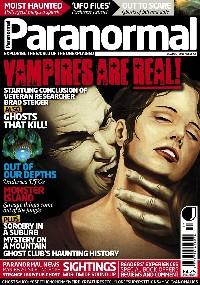
Are Vampires Real? - December 2009 - Paranormal Magazine (UK)
Tyra Banks Show - "Vampires" w/Don Henrie, Sarah Lester, & Vampyra Friday, October 31, 2008
Think vampires aren’t real? Wait until you meet these guests! With the
popularity of HBO’s “True Blood” and the “Twilight” series, teen books
that focus on vampires, Tyra delves into the mysterious world of
vampires as she meets some of these nocturnal beings. We’ll learn how
and why these guests embrace the vampire lifestyle!
The Vampirism & Energy Work Research Study is a detailed sociological and phenomenological study of the real vampire community conducted by Suscitatio Enterprises, LLC (http://www.suscitatio.com). The specific focus of this study concerns individuals who personally identify as psychic and/or sanguinarian vampires. Two surveys were released in 2006 that were answered by over 950 individuals from all paths within the vampire community and throughout the World. The first was the Vampire & Energy Work Research Survey (VEWRS) with 379 Questions in March 2006; and the second was the Advanced Vampirism & Energy Work Research Survey (AVEWRS) with 688 Questions in August 2006. From 2006 to 2008 a combined response total (VEWRS & AVEWRS) reached over 1,450 surveys or over 670,000 individually answered questions; making it the largest and most in-depth research study ever conducted on the real vampire community or subculture. Not only are we now able to provide the organization and quantification to questions vampires have been asking themselves for years, but we have increased the standard of research and subsequent analysis on the community through the creation of such a vast body of data. SURVEYS: (Click Links To View/Download)
MonsterQuest - History Channel - "Vampires in America" Wednesday, August 6, 2008 @ 9:00 PM ET
"A vampire scare in New England in the 1700s lasted more than a century
and turned families and communities upside down. The dead bodies of
those suspected of vampirism were exhumed and ancient curse-breaking
rituals were performed on them. Watch as the latest technology is used
to analyze historic evidence of the New England vampires and discover
if there was any basis for the panic. Medical science is also used to
examine those who believe themselves to be modern day vampires. Is
there a common element between the suspected vampires of America's past
and present?"
Relevant Information Recap:
Minute 28-29: Rod Ferrell - KY "Vampire" Killer + Diagnosis w/Aspergers Syndrome Minute 30: Matthew Hardman - UK "Vampire" Killer (Konstantinos & Katherine Ramsland sprinkled in here and there throughout) Minute 31: Joy Poulos (Dominae Drakonis) - Agrees to hematological testing in NYC Minute 43: Porphyria Discussion w/Doctor (Unrelated to Joy, etc.) Minute 43:
White & Red Blood Cell Counts / Platelets / Other Results =
Completely Normal. Hematologist stated there is no evidence to support
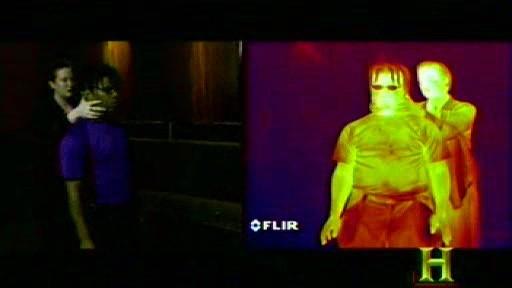
anything abnormal about Joy based on her blood tests. Minute 44: Psychic Vampires / Michelle Belanger w/Raxx (HK Member) - Basic Background On Michelle & Psychic Vampirism Minute 45-46: Dom Villella, a paranormal investigator, attempts to record an energy shift between Michelle & Raxx Minute 52-54: Actual Testing Trials a.) FLIR (Forward Looking Infrared) Camera - Detects Temperature Variation / Changes Result:
When pushing energy into Raxx; Michelle's hands went from orange to
yellow (hotter). Unusual, but not a "concrete" finding. b.) Multimeter / Voltage Meter - Detects Changes In Electrical Current Result: Baseline established for both; when holding hands = 80; 30-90 is average for two individuals c.) Electromagnetic Field Detector (Trifield Meter) - Detects Changes In Electromagnetic Fields Result:
Baseline = "0"; Michelle caused spike to "2". Don noted that "1" was
the highest level he had previously seen. Stated that there was a
definite manipulation in the electromagnetic field when tested on
Michelle. Videos Unavailable At This Time
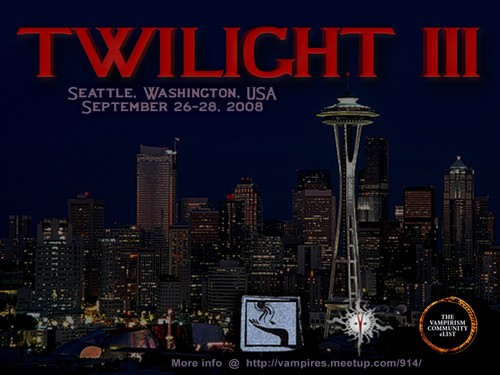
TWILIGHT - A Formal Gathering Of The Vampire Community
TWILIGHT I - Los Angeles, CA - October 30, 2007 TWILIGHT II - Atlanta, GA - March 7-9, 2008 TWILIGHT III - Seattle, WA - September 26-28, 2008 TWILIGHT IV - T.B.A.
Vampires. The word itself conjures up different meanings for different people. For some it's the fictional characters that grace the novels of Anne Rice and for others it's the parasitic, blood thirsty creation of Hollywood. They are perceived as entertaining at best and frightening at worst. But what are they really? Join us today as we interview Zero and Merticus. They are both with Suscitatio Enterprises, LLC and the Atlanta Vampire Alliance. Zero and Merticus will help us understand the defining characteristics of the modern day vampire and the role of their organization within the vampire community itself.
There are many misconceptions with regards to vampires and vampirism. How would you define a modern-day vampire?
Most of those misconceptions derive from the fact that the modern-day Vampire Community is using the word "vampire" in a metaphorical sense, and from the tendency of outsiders to ignore the context of this use. When a member of this community describes themselves as a "vampire," they are not trying to tell you that they think they're a fictional character with supernatural powers, that they have trouble distinguishing between a role-playing game and reality, or that they hope you're gullible enough to believe that they're hundreds of years old and live in a castle. They're not even claiming kinship with the folkloric monster that frightened the people of Central Europe, and has them performing vampire-banishing rituals to this day.
Many casual treatments of the Vampire Community by the press and pop media gleefully ignore the metaphoric use of the word "vampire" and leap to cinematic conclusions about those who identify themselves as vampires. Of course, they never really firmly establish what a "vampire" is, much less the details of the vampire delusion. This is because members of the Vampire Community don't really "think they are vampires." The label has been taken as a statement of identification, not with myth or fiction, but with one another, and the experiences that real vampires seem to share. This use of yellow journalism contributes not only to the misconception that modern vampires identify with fictional vampires, but also to the misconception that members of this community are an extreme manifestation of another subculture - role-playing gamers, vampire fiction enthusiasts, Goths, or even body modification or blood fetishists. These diverse subcultures have all been erroneously referenced as recruiting grounds for the modern vampire subculture.
This goes as well for the misconception that modern-day vampires constitute a religious movement. While understanding the modern vampire phenomenon often requires a discussion about "belief," the belief in question is in psychic phenomena. Vampires often perceive their experiences in psychic and energetic terms, which can't currently be scientifically measured. So while there is often a belief element involved in discussing the vampire community, it's really just the fact that many in the community are willing to accept paranormal and ESP events as a possible framework to understand their experiences. If vampires are going to be classified as a new religious movement based on their acceptance of the paranormal as a possibility, the entire paranormal research community would also be members of that same religion.
Other misconceptions about members of the Vampire Community come from an entirely different direction - while pop media tends to treat self-described vampires as ordinary people with strange, and necessarily false, self-perceptions, the occult literature believes, but doesn't approve. Most of what has been written about vampirism in occult, Neopagan, and New Age literature has been negative, based on the understanding of vampirism as a real psychic event, but characterizing the vampire as predatory and destructive; the vampiric person of occult literature takes energy unethically and selfishly, and leaves behind him a trail of ruined lives and relationships. This portrayal has led to a widespread prejudice against the vampire community among other occult and Neopagan subcultures. It's important to understand that much of the source material for this understanding of vamprism comes from the 1920-30's books of Dion Fortune, written long before vampires were a self-aware community. Whether Fortune encountered a few unscrupulous individuals, or she dealt with vampires who weren't even aware of their vampirism, her description doesn't hold much water in the modern Vampire Community, where vampires trade tips on responsible behaviour and discuss ethics like it's a national pastime. One of the things we hope to accomplish by distributing data from the Vampirism & Energy Work Research Study is to put some of that old prejudice to rest by allowing vampires speak for themselves about their own personal ethics, beliefs and practices. Contrary to this common misconception, vampires are highly concerned with the effect their actions have on the people around them. The community has collectively put a lot of effort into the discussion of how to be a balanced and positive presence rather than parasitic.
Real vampires are neither delusional nor are they predatory, psychically or otherwise. They don't style themselves after fictional characters, and 60% of our survey respondents said they didn't even consider themselves Goth. And vampires have sent back surveys to us identifying themselves as Christian, Buddhist, Left-Hand-Path, Wiccan, and Daoist, among many, many others. It seems that vampires have religions, they don't comprise a religion in and of themselves.
So if vampires aren't any of these things, how can we define a vampire? The fact is, we tend not to. Vampires have an emerging identity that's built from the experience of being as they are - vampires use introspection, self-awareness and the sharing of their experiences with others to create a collectively-discovered picture of what it means to be a vampire. This is entirely a process of discovery, so rather than there being some central vampiric ideal that we're aspiring to, we think of what a vampire is by thinking of what we know to be true of ourselves, and of the similarities in experience that others like us share. Furthermore, that discovery process is ongoing - we still don't know exactly what makes a person a vampire, or how vampires get to be the way they are. The only common ground that vampires generally agree upon is that vampires share a need to feed on either blood or psychic energy in order to sustain their well-being. The need to feed, and the associated blood hunger or energy deficit are the only things that the Vampire Community can agree on that we know set us apart from other people. There are other experiences that may go along with being a vampire, which will get discussed below, but they aren't well-understood or universal enough to provide us with a definition of vampirism. Taken collectively, however, these experiences are what make our lives similar to one another's and different from the average, ordinary life, and they are what form our understanding of ourselves as vampires.
How widespread is this phenomenon?
There is no way to tell how many vampires there are in the world, partly because individuals are solely responsible for their own self-identification. The standard wisdom from the community is that only you can decide whether or not you are a vampire, after serious self-aware introspection. The Vampire Community online and in the real world has definitely been growing in membership, but that's due to many factors. First, not everyone who participates in the Vampire Community, whether online or offline, is actually a vampire. Some just like the community atmosphere, and the Vampire Community rarely turns away anyone who wants to engage in healthy socialization. Second, the increase in widespread communication means that more interested individuals can find the community today, whereas we can only assume that in the past, real vampires may have gone their entire lives without discovering that there were others like themselves. Today, after receiving completed VEWRS/AVEWRS surveys from dozens of countries, and having received requests to translate the text of the survey into multiple languages, we know for certain that there are self-identifying vampires all over the world, that this is not just an American, or an English-speaking, or even a Western-Hemisphere phenomenon. We have heard from vampires in Asia, Europe, South America, and North America. However, we have nothing like a vampire head-count, and no foolproof vampire test to tell whether everyone claiming to be a vampire actually is one. We can say the Vampire Community has been growing in participation and visibility, but there's no way to tell what percentage of the population might be vampiric.
What are the defining characteristics of a vampire?
There is now a visible and vibrant community of people who are using the label to describe themselves, but to this day there is no functioning definition of a real vampire. This is primarily because no one knows what the cause of the phenomenon actually is, and the community has coalesced around a set of loosely shared perceptions and symptoms rather than a central organizing principle. Therefore, we can describe some common experiences involved in being a vampire, but these shouldn't be taken as a definitive vampire checklist. There are no known necessary and sufficient conditions to be met before you can be a vampire. Likewise, there's no single definitive sign that someone is not a real vampire.
That said, the most common experience vampires share is the need to take in life energy or blood, from sources outside themselves, to maintain spiritual, psychic, and physical health. Blood-drinking, or sanguinarian, vampires have to consume small, polite amounts of human blood from willing donors. The majority of respondents to the survey reported taking only an ounce or less at a time; usually no more than once a week. Feeding is absolutely a health necessity; vampires have reported many negative physical symptoms when trying to ignore this need to feed. Psychic vampires, or psivamps, feed on psychic energy. Some psivamps enter into relationships with donors in the same way that sanguinarian vampires do, while others consciously train themselves away from human energy altogether, either for convenience or as a result of personal ethics. Some psivamps report a natural affinity for feeding on natural sources such as elemental or ambient natural energy. Others cultivate techniques for absorbing ambient energy from crowds and public places, so as not to take from any one source.
Many vampires are nocturnal and have difficulty with school and day shift work. Many are visually photosensitive and get physically ill from sun exposure. Others will mention having unusual sensory perceptions, from the basic five senses, like light and smell sensitivity, to more esoteric extrasensory experiences. Many vampires reported seeing ghosts, having psychic dreams, or perceiving spirits, but some vampires have never had any ESP or PRE experiences. At this time, there is no scientific theory explaining why vampires need to feed, or why they tend to do so in very particular ways. It's at the center of the vampiric identity, intensely experienced, and yet to this day unexplainable. We hope that one day this need will be better understood and that our study will serve as a catalyst for increasing scientific and medical interest in future research into this phenomenon.
What does your organization offer to the field?
Our major contribution at this time is our inaugural research project, the Vampirism & Energy Work Research Study. We released the Vampire & Energy Work Research Survey (VEWRS) in March 2006 and the Advanced Vampirism & Energy Work Research Survey (AVEWRS) in August 2006. Combined, these surveys ask over 988 questions, which were answered by over 650 individuals from all corners of the Vampire Community. The questions covered many topics of interest to not only ourselves and fellow vampires, but to outside researchers as well. We hope that the completed study will offer two very useful contributions, both to vampires and to people who want to know about vampires.
First, we will provide organization and quantification to the information that vampires have been informally passing amongst themselves for years, to give the community a chance to tell itself about itself. Much of what we asked were questions we had been asking ourselves, on Internet message boards, chatrooms, and other informal meeting places. Vampires want to know what's "normal" for being a vampire, how much of what they're experiencing is shared by others.
And second, we'll be able to address the academic research that is starting to be done with this community. At the point when we started the project, there was no real body of data against which research could be judged, and most outside analysis was openly hostile, ranging from the sensationalist to the alarmist. There didn't seem to be a standard of proof needed to make armchair analyses of the community based on poorly conducted website research, and these analyses always painted some lurid picture of a youth delusion, or worse, a "vampire cult" that would engage in occult practices, ritualistic sacrifice, or even cannibalism. We intend for the body of data we are gathering to show what this community looks like when someone conducts responsible research, and to raise the standard of proof that researchers will need to meet in order to make claims about this community and its members.
How can people contact you?
Our primary e-mail address is research@suscitatio.com. We are updating the community on our progress and future research initiatives at http://www.suscitatio.com
How do people take part in your study?
After almost two years of survey submissions, the deadline has finally passed (October 31, 2007). You may still view the surveys at our website along with all associated charts, graphs, and other statistical analysis. As of November 2007 we are currently engaged in the data-entry phase of this research study.
Do you have any upcoming educational events or related events that you either produce or you endorse?
In the past we've had community-based events hosted everywhere from Georgia to Ohio to California where we have presented our research and preliminary findings to members of the community. We have several events we are either organizing or plan to attend in 2008 and the details will be posted via our web site at: http://www.suscitatio.com
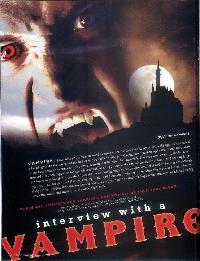
TAPS Paranormal Magazine October 2007 Special Halloween Edition "Interview With A Vampire"
[Click To Enlarge]
[Click To Enlarge]
[Click To Enlarge]
[Click To Enlarge]
[Click To Enlarge]
The Secret Life Of Vampires - A&E October 28, 2005
This A&E Special Presentation gives viewers a chilling close up of the modern world of vampires. There's the bewitching young couple who relishes their vampire lifestyle and each other's blood. And Michelle Belanger who extols the spiritual side of vampirism as she guides viewers into her own hidden world's a vibrant and diverse society with its own rules, conventions, politics, language, customs and as opinionated as our own.
Is being a vampire really all about blood and death, or is it about living life to its fullest? Why do some vampires seek blood, while others sustain themselves on the "life-force" of others? In a small town in Canada viewers meet a 42-year-old grandmother (Lady CG) who shops at Wal-Mart and enjoys gardening. Every Sunday night she gathers fellow vampires around a campfire and talk about local politics, personal issues, and safe sources of blood. In a TV first, viewers get a first-hand look at one of these meetings. A young New York City vampire (Father Sebastiaan), who people are generally afraid of, practices a bloodless vampirism that involves taking the physical or sexual energy from a willing donor. A devotee named Don Henrie sleeps by day in a closed coffin and hits the town at night to prey on willing energy donors.
This A&E Special Presentation asks, "If Vampires are all around us, where do they come from?" Modern day vampires practice something deeply rooted in the human spirit and history. The link between blood, life, and death can be found in ancient cultures around the globe. Viewers visit Dracula's birthplace, the ruins of his mountain castle, and his burial tomb. They also visit a small town in Romania where last year panicked villagers, thinking they had a vampire in their midst, dug up corpses and drove stakes through their hearts. Viewers also learn that most vampires are very fussy about what goes into their body, particularly if they drink blood. And vampires who feed off of each other have a bond of intimacy, sometime sex, sometimes ritual. One vampire says that once you have tasted another's blood you are bound to them forever. The drinking of human blood is the pinnacle of what most people consider to be true vampirism. Viewers see a demonstration of human bloodletting and drinking.
Copyright 2006 - 2020; Voices of the Vampire Community (VVC) - All Rights Reserved. No portion of this website may be reproduced, transmitted, modified, or used as source material without prior expressed written permission from the VVC. General Inquiry: VVCNotification@gmail.com | http://www.veritasvosliberabit.com/contactus.html